
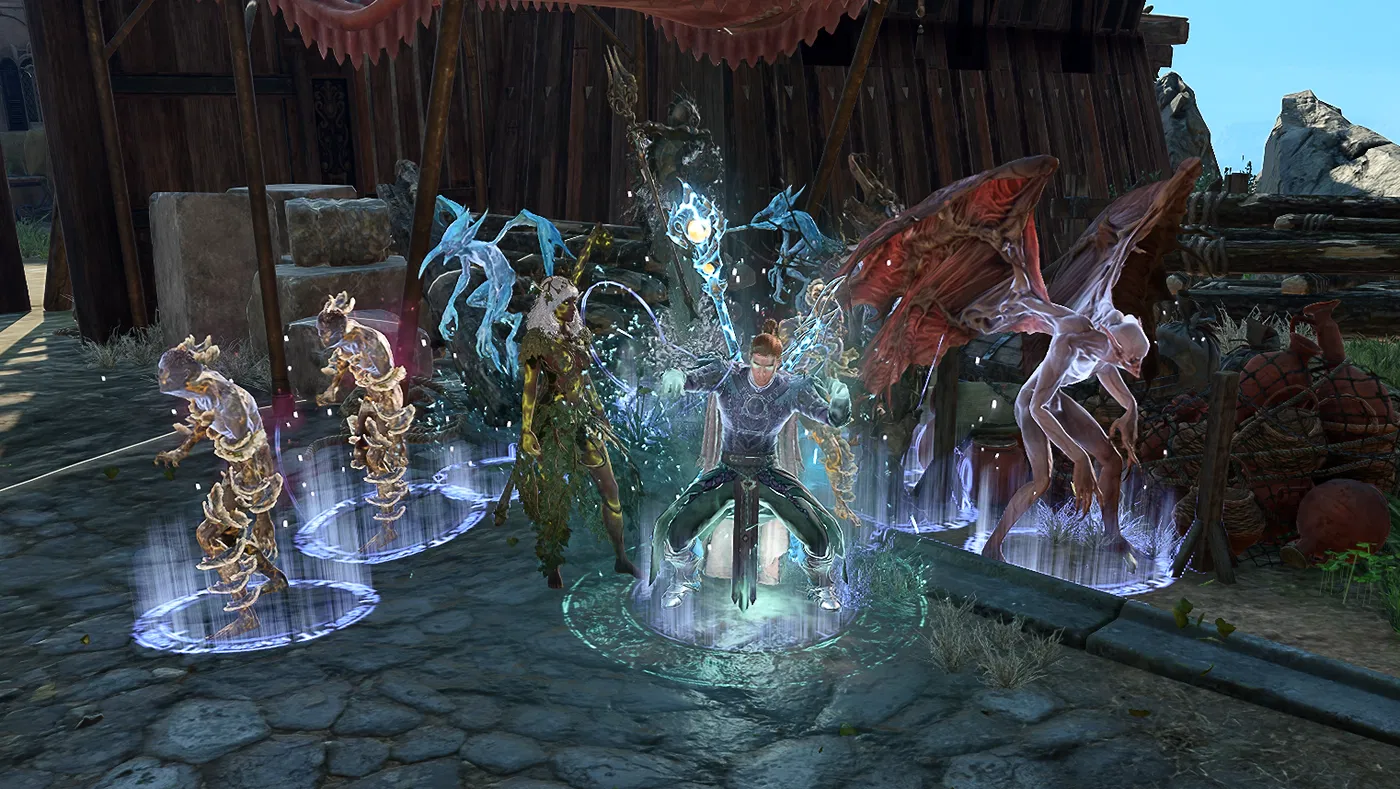
Spore Druid - Summoner Build - 20+ Summons - Baldur's Gate 3 (BG3)
Contents
- Spore Summoner Build - Lord of Spores
- Build Overview
- Synergy with other builds
- Level 1 - Character Creation
- Act 1 - Levels 2-6 - Wilderness
- Act 1.5 - Level 7 - Rosymorn Monastery
- Act 2 - Level 8-10 - Shadow Lands
- Act 3 - Level 11-12 - Rivington and Lower City
- Maximizing - Abilities, Illithid Powers, Consumables
- Conclusion
Spore Summoner Build - Lord of Spores
Spore Druid is a very interesting subclass. On one hand, you have the core Druid kit - control spells,  Wild Shape form, and good proficiencies. On the other hand, Spore Druid comes with its own tools and spells that expand your capabilities and how effectively you can use resources.
The build has two aspects, which can function together or separately - an offensive control caster and a Summoner. The former is pretty simple - use powerful spells to disable or eliminate enemies. The latter part is somewhat more difficult to utilise well, but can still be extremely fun.
In Baldur's Gate 3, "summoner" is a bit different due to the nature of turn-based combat. Summons are usually not that strong, and with a large amount of them, you might spend most of the combat doing nothing, while the time you spend in it grows exponentially. Of course, with this build, we will try to optimise this part to be as effective as possible.
The Caster aspect of the build is a powerful toolkit -  Sleet Storm,
  Confusion and many other spells. But Spore Druid gives one seemingly minor but powerful tool -
  Halo of Spores, which is activated when running
  Symbiotic Entity. This action is very cheap to use and enables you to play around with various consumables - drop them on the ground, and destroy them to spread their effect.
The summoner part for Druid and Spore on top is huge -  Conjure Elemental,
  Conjure Woodland Being,
  Animate Dead,
  Fungal Infestation and many more. You will have a powerful army following you that can take action whenever you need. If your fantasy is being Lord of Summons, this is the best build for that.
So the build ends up as two parts, which you can use together or separately, depending on what you want to achieve. If you find Summons boring, you can still use the Spore Druid kit to play around with Halo of Spores,  Contagion,
  Spreading Spores,
  Cloudkill and others.
Following the guide and a few tips:
- Build Overview covers the quick aspects and choices for the build - gear, levelling, etc.
- The progression by Acts cover the build in great detail, from spell selection to how utilize various features. Be sure to check the equipment sections for gear options and explanations. The mechanics section explains how to fully utilize the build in combat
- I also add additional section for build maximizing like consumables, illithid powers and others. This can help to make the build even more powerful and optimised if needed.
Class Contribution
The build consists mainly of 2 classes:
11 Spore Druid
Spore Druid is packed with features from both summoning and spellcasting aspects:
- Capability to Prepare spells - this enables the Druid to change spellbook when not in combat, to utilise different spells depending on the situation. Utility spells -
 Guidance,
  Create or Destroy Water,
  Enhance Leap, etc. Control Spells - Sleet Storm,
  Spike Growth,
  Plant Growth, Confusion, etc., offensive -
  Ice Storm,
  Wall of Fire, etc.
 - Wild Shape - the iconic feature of Druids, allowing them to change into different animals, with a separate HP bar, ability scores and special actions.
- Extra attacks for Wild Shape with
 Wild Strike and Improved Wild Strike, resulting in 3 attacks for the base action.
 - Symbiotic Entity - the unique feature of Spore Druid, giving a layer of temporary HP based on Druid level and providing additional damage rider on weapon attacks. Can only use this or Wild Shape, not both.
- Halo of Spores is an interesting action accessible to Spore Druids. You can deal additional damage using your reaction. This can be used to destroy objects or finish off enemies with low HP.
- Additional necrotic themed spells -
 Blindness, Animate Dead, etc.
 - Access to lots of summons - Fungal Infestation, Conjure Woodland Being,
 Conjure Minor Elemental, and many more. Each of these provides a higher total group HP pool and comes with powerful features. For example, Conjure Woodland Being offers another summon and free Spike Growth.
 - Spreading Spores - offers a cheap way to inflict area of effect damage, without hitting allies.
 Heroes' Feast - gives a significant health boost to all party members and poison immunity.
1 Wizard
- Spell Scribing is the main highlight of Wizards, allowing them to learn any spell from scrolls and put it into their spellbook. Later, it can be assigned to Prepared spells and used during exploration or combat.
Build Variations
Here are some variations that work similarly and utilise the same classes at their core.
| Setup | Description |
|---|---|
|
Similar setup to the one offered here, which is perfect if you do not have a dedicated cleric in the group for upcast
I recommend taking the 1st level as a Cleric, and continue in Druid to level 8, after that finish with Cleric, and finally add Wizard. |
Necromancer Build:
|
A thematic necromancer build that mainly uses undead summons and necrotic spells. It offers a very fun playstyle and a manageable number of summons to make the combat okay. |

Build Overview
Here is a concise table with all the main picks during your levelling progression. For more detailed reasoning, I go further in the article. Also, do not forget to check the recommended gear, as it is crucial.
This is a general overview of the build that contains item and leveling choices. I go deeper into the setup, combat approach and gear selection reasons for the progression of each act.
Leveling
| Level | Class | Selection |
|---|---|---|
| 1 | Druid 1 | Cantrips:  Shillelagh, Guidance Shillelagh, Guidance |
| Abilities: +1 Wisdom from  Auntie Ethel's Hair: STR - 10, DEX - 16 (15+1), CON - 14, INT - 8, WIS - 17(15+2), CHA - 8 Auntie Ethel's Hair: STR - 10, DEX - 16 (15+1), CON - 14, INT - 8, WIS - 17(15+2), CHA - 8No Auntie Ethel's Hair: STR - 12, DEX - 16 (14+2), CON - 14, INT - 8, WIS - 16 (15+1), CHA - 8 |
||
| Skills: Animal Handling, Medicine, Insight | ||
| 2 | Druid 2 | - |
| 3 | Druid 3 | - |
| 4 | Druid 4 | Feat:  Dual Wielder or Ability Improvement +2 Wisdom Dual Wielder or Ability Improvement +2 Wisdom |
| 5 | Druid 5 | - |
| 6 | Druid 6 | - |
| 7 | Druid 7 | - |
| 8 | Druid 8 | Feat: Ability Improvement +2 Wisdom or Dual Wielder |
| 9 | Druid 9 | - |
| 10 | Druid 10 | Cantrips:  Thorn Whip Thorn Whip |
| 11 | Druid 11 | - |
| 12 | Respec: Wizard 1 Druid 11 |
Cantrips:  Minor Illusion, Minor Illusion,  Friends, Friends,  Light Light |
Spells:  Shield, any Shield, any |
Gear Choices
Build ID: 58
Mode: Paper Doll
Sets: All
Synergy with other builds
The build has various synergies with other builds, from being an easy source of  Wet to a commander of an army of undead and summons. Let's see what synergies we can unlock
Having a Cleric in the party
A dedicated Cleric build, especially with  Aid + Heroes' Feast (druid gets access to it, so not as important), can go a long way, as they will drastically increase the survivability of the summons. Moreover, with
  Spirit Guardians, they can debuff enemies using
  Gloves of Belligerent Skies +
  Luminous Armour +
  Boots of Stormy Clamour. This results in lots of
  Radiating Orb,
  Reverberation and, most importantly,
  Prone. This gives an easy
  Advantage and greatly increases undead hit chance.
In addition, they get  Glyph of Warding, which has a variation -
  Glyph of Warding: Sleep. This gives an easy source of critical hits and also forces enemies to skip turns.
Here are some build recommendations:
- Light Cleric
- Tempest Cleric
- Revorb Blender - cleric-like build
- War Domain Cleric
- etc.
Characters with high Strength
The build relies on corpses for resurrecting undead, and one strategy of getting bodies is to pick them up and store them in your stash for later use. The main caveat is that they are quite heavy, and in many cases, without something like  Elixir of Hill Giant Strength, you will not be able to pick them up. A solution is to use another build that has high strength. Here are a few recommendations:
- Wildheart Barbarian
- Thrower builds - EK Thrower, Berserker Thrower or Giant Barb
- Standard frontliner builds - Eldritch Knight, Battle Master, Paladin Builds, etc.
Combatants that can Prone, Sleep or Disable enemies
To make summons hit as hard as they can, you need either Advantage or ensuring they can crit. I already covered clerics. Here are the builds that I recommend keeping in mind:
- Clerics - for Prone and
 Sleeping via Glyph of Warding: Sleep.
 - Wildheart Barbarian, Berserker Thrower - can Prone enemies and greatly weaken them
- Casters like Bards and Wizards with access to Glyph of Warding: Sleep
- Casters with access to
 Hold Person and
  Hold Monster. These are, namely, Fire Sorcerer, Storm Sorcerer, Bardadin and others.
Cold and Lightning casters
The build also has access to Create or Destroy Water and can apply Wet status by casting Halo of Spores on  Water that is dropped on the ground. It's a very cheap source of making enemies vulnerable to lightning and cold damage.
- In terms of cleric choices Tempest Cleric is the best pick. They get
 Call Lightning and more theme-related spells + effects to utilize Wet conditions.
 - Sorcadin with access to
 Lightning Bolt.
 - And.... Many of the Sorcerer variations - Storm Sorcerer, Talos Dragonling Build, etc. Bladesinger is another option, as it has access to all standard caster spells.
- My personal favourite - Abjuration Wizard Tank. It deals cold damage with
 Armour of Agathys. Of course, as a wizard, it can still cast all the Cold/Lightning spells. But it might need to walk on the Spike Growth, which would eat away its
  Arcane Ward.
Level 1 - Character Creation
This section covers the creation screen and what would go into the best Races, Abilities, and Skills for the Necromancer build. If you have already started playing, feel free to do a respec at Withers and follow along. This will make it easy to follow the build step by step.
Races
Picking a race provides various benefits - abilities, dialogue options, looks, etc.
| Race | Features | Description |
|---|---|---|
 High Half-Elf High Half-Elf |
|
Comes with a selection of additional cantrips and shield proficiency. Overall, it's a list of solid features. |
 Dwarf Duergar Dwarf Duergar |
|
It's one of the most powerful races. At level 5, they gain  Invisibility, which enables various ways of avoiding direct combat encounters, leaving them or breaking enemy AI. Invisibility, which enables various ways of avoiding direct combat encounters, leaving them or breaking enemy AI. |
 Human Human |
|
You will need to pick up dead bodies, so having extra inventory capacity is definitely great. |
| Wood Half-Elf |
|
Almost any build can benefit from the extra movement speed. I think the same is here, so I definitely recommend this option |
 Wood Elf Wood Elf |
|
|
 Halfling Halfling |
General good race, with multiple rerolls helping to avoid failing various checks, spells and saving throws. | |
 Deep Gnome Deep Gnome |
|
With a general Advantage to mental checks with  Gnome Cunning, it's easy to resist deadly spells. Gnome Cunning, it's easy to resist deadly spells. |


Class Choices
This section will cover what class-related choices you should pick for the optimal setup
Class
| Overview | |
|---|---|
 Druid Druid |
|
| Druids channel the elemental forces of nature and share a deep kinship with animals. Mastery of Wild Shape allows them to transform into beasts from all over the Realms. | |
| Features | |
 Spell Slots Spell Slots |
These can be used to cast spells and are restored each long rest. |
Cantrips
| Cantrips | Description |
|---|---|
| Guidance |
Pick this if you do not have a cleric in the group. This is the most useful cantrip in the game that helps with almost all ability roll checks. |
| Shillelagh |
This is a very good cantrip in the early game. It enables you to make  Torch one of the strongest early-game weapons while also having a shield. Torch one of the strongest early-game weapons while also having a shield. |
Prepare Spells
Here are my recommendations on spells that are good to be added to the prepared spell list.
The Prepared Spell feature allows you to select a smaller number of spells to be usable from your spellbook. It means that only those "Select few" can be used during combat. Generally, the number of spells you can prepare is "class level" + spellcasting modifier.
So for casters with this functionality, the spell options are "recommendations" rather than direct picks, as this depends on your level, spellcasting modifier and other aspects.
| Spells | Description |
|---|---|
 Healing Word Healing Word |
Excellent spell for the early game, where you might need an instant recovery of an ally. The spell is very cheap to use and only consumes a bonus action. |
| Create or Destroy Water |
One of the S-Tier spells, that is good to have in your arsenal. You can use it to apply Wet on enemies for double Ice and Lightning spell damage from yourself or allies. |
 Thunderwave Thunderwave |
It is a powerful spell that you can use to push enemies off ledges for instant kills. |
 Ice Knife Ice Knife |
Great spell early in the game, that can deal decent damage and apply Ice surfaces for enemies to slip. |
 Faerie Fire Faerie Fire |
Excellent early game spell, where getting Advantage for your party members might be difficult. Use this to improve their hit chances. In the mid-game, I would remove this. |
 Longstrider Longstrider |
At least one party member needs to have this spell in the group, as it gives a free movement speed boost and can be cast multiple times outside of combat. Use it after each long rest. |
Background
Backgrounds are generally for roleplay and skill proficiency, so in a generally well-made party, they will serve minimal purposes.
- They give a role-playing option of your previous history, if you are into that.
- It gives skill proficiencies, meaning that you get an additional bonus when you roll that skill check in which you are proficient. This depends on your proficiency bonus, which increases as you level up.
Here are my recommendations based on this build
| Background | Skills | Description |
|---|---|---|
| Guild Artisan | Insight Persuasion |
A great choice, especially as you also get persuasion for better dialogue outcomes. |
| Folk Hero | Animal Handling Survival |
Useful choice, that gives two wisdom-related skill proficiencies. |
| Acolyte | Insight Religion |
A somewhat mixed bag. Insight is good, for some game situations, but religion is not related to many impactful things. |
Abilities
Now, let's take a look at the abilities of the Necromancer build. Correct allocation will allow you to maximise the early gameplay and get good modifier bonuses.
Here are some key points to know about ability points:
- They give "ability modifiers" that apply to various skill checks. For example, Charisma works on Intimidation and persuasion checks. Wisdom on Survival or Animal Handling, and so on.
- You get a higher ability modifier on even values - 10, 12, 14, etc. So keeping it on odd may be useless. However, there are various +1/2 modifiers in the game, specifically Auntie Ethel's Hair or Feats that help round this up.
- Weapons can benefit from either Dexterity or Strength, depending on their type
- You also have a spellcasting modifier, which can be Wisdom, Charisma, or Intelligence, depending on your class.
Build ID: 58
Skill Proficiencies
Overall, skill selection should be influenced by your role-playing and background decisions. However, you generally still want options that offer the best benefits. I recommend picking skills for which you have a high ability modifier or those that are useful in general:
- Animal Handling
- Insight
- Medicine
- Survival
Act 1 - Levels 2-6 - Wilderness
By this time, you should have landed on the  Ravaged beach already and started exploring the initial area. You might need 1 additional encounter if you did not obtain enough XP in the Nautiloid.
Leveling Progression
Level 2 - Spore Druid
This is an important level as it will unlock the subclass - Circle of the Spores that the build needs.
| Subclass | |
|---|---|
 Circle of the Spores Circle of the Spores |
|
| Features | |
 Wild Shape Charge Wild Shape Charge |
Allows transforming into a beast using Wild Shape. For spore druid, it is used for activating the Symbiotic Entity. |
| Halo of Spores |
This is a very useful feature that allows not only to inflict extra damage, but destroy items that are on the ground. This unlocks using various potions or consumables to weaken enemies or help allies. |
| Symbiotic Entity |
Adds a decent 1d6 damage rider and temporary HP based on your druid's level. |
 Bone Chill Bone Chill |
Very situational cantrip, that can be useful in a few fights throughout the game. |
For Prepared spells, just add anything. Add level 1 spell, if you have not already. You can include Enhance Leap as a good utility addition.
Symbiotic entity and increased damage
So one of the unique druid cantrips is Shillelagh. It is very effective in the early game, where you can make a weapon like Torch, one of the strongest weapons. Symbiotic Entity also helps by giving an additional necrotic damage rider, giving a decent damage boost.
Another option is using a bonus action attack via  Hand Crossbow +1 for an additional necrotic damage boost.
Utilising Halo of Spores in creative ways
So, Spore Druid, when having Symbiotic Entity active, can use Halo of Spores This is a really neat feature, which can help deal additional damage. But that is just scratching the surface.
Where the action really shines is when you use various items, specifically potions - healing,  Potion of Speed,
  Void Bulb and others, to drop them on the ground from your inventory. Now you can destroy them using Halo of Spores. So something like Potion of Speed now can cover multiple allies with a single activation, saving you precious resources when destroyed on the ground.
Another good option is Water. You can drop it for free on the ground and move to the enemy. Destroy it with Halo of Spores to get instant Wet and use cold/lightning spells for double damage.
Wild Shape forms
As all druids, you get access to Wild Shape. This is a pretty substantial feature, and in various situations can be a lifesaver:
- Gives a separate HP bar, which helps avoid dying in certain situations.
- Enjoys the benefits of Wild Strike and Improved Wild Strike for extra attacks
- Comes with unique features and actions, like
 Wild Shape: Owlbear against Grym (Lv. 10), or
  Wild Shape: Deep Rothé for Prone activation.
Still, as a spore, you will want to activate Symbiotic Entity most of the time. This uses the same resource as Wild Shape, so you will have certain limitations. But the key point is that you will have a substantial boost in temporary HP and gain a very useful feature - Halo of Spores.
Picking up Dead Bodies
As a necromancer, you will really like dead people a lot. The spells in the first levels can be easily cast using spell slots. The problem arises later on, once you get Animate Dead and want to use various zombies and skeletons - each of them will require a dead body.
You might encounter a problem where the body weighs too much. What to do then? Either have a companion with high strength, equip  Club of Hill Giant Strength, or drinkthe Elixir of Hill Giant Strength, which I will cover next
Good thing, this game allows you to pick up these and stash them in your storage chest (they weigh a lot). So once you see a dead body, and you have looted it, right-click on it, and pick it up

They weigh a lot so instantly transport them to your storage chest:
- Go to camp
- Store in the Traveller's Chest
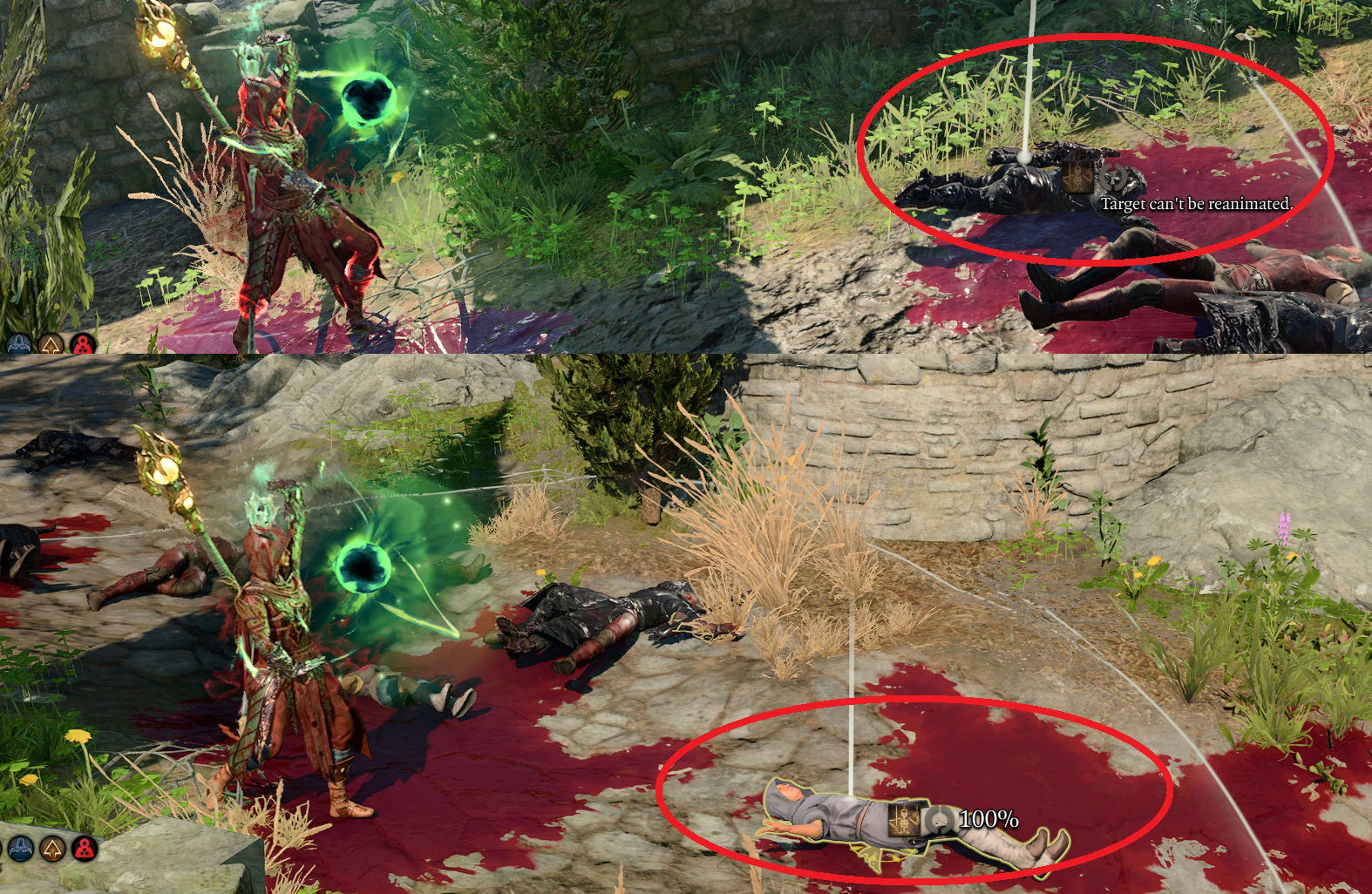
There is a caveat. If the body is burned or killed via necrotic damage, you will not be able to resurrect the undead from it. Try to pick up "clean bodies" (as crazy as it sounds)
Stacking on Strength Elixirs
The Elixir of Hill Giant Strength can serve you extremely well, not just for carrying bodies but also later on, empowering your undead buddies summoned with Animate Dead. These summons can drink the potions (When they are dropped on the ground), to have their strength value increased, making them much stronger.
I recommend checking the Strength Elixir farming guide on how to stock up on these really easily, as there is a perfect spot in Druid's Grove in Act 1 for that.
Level 3 - Druid Lv 3
This level is mainly for unlocking the new level 2 spells. First, you get additional Spore Druid spells by default:
| Spell | Description |
|---|---|
| Blindness |
A very good spell, which applies Blindness while not requiring any  Concentration. This can help to greatly weaken enemies, while you maintain other spells. Concentration. This can help to greatly weaken enemies, while you maintain other spells. |
 Detect Thoughts Detect Thoughts |
Semi-useful spell, that allows for special dialogue interactions. |
Let's go through a few recommendations that I think are worthwhile to include in Prepare Spells. You can also remove any of the spells that you did not use.
| Spell | Description |
|---|---|
| Spike Growth |
Really powerful spell, that can cover choke points, slow down enemies and inflict significant damage. It can also pass on riders like  Lightning Charges, Radiating Orb, etc. Lightning Charges, Radiating Orb, etc. |
 Enhance Ability Enhance Ability |
I recommend at least one party member having this spell, as it can greatly help in various dice rolls for an easy Advantage. |
| Hold Person |
For now, this spell might have a low success chance, but later on, you can paralyse an enemy, which makes your allies and summons get easy Advantage and guaranteed critical hits. |
 Heat Metal Heat Metal |
Decent spell, that can disarm enemies. Sadly, it does use your Concentration slot, which is quite expensive option imo, but can disable strong foes. |
 Moonbeam Moonbeam |
Casting the spell one time enables you to recast it without any issues on the next turns. |
Level 4 - Druid Lv 4
You do get one nice addition from the base Druid class:
| Form | Description |
|---|---|
| Wild Shape: Deep Rothé |
Excellent option for early games, as it can hit multiple enemies and make them Prone. This will make it easier for others to hit them. Sadly, becomes mediocre later on as the HP pool is very low. |
You also get to choose a cantrip. My recommendation would be:
| Cantrip | Description |
|---|---|
 Produce Flame Produce Flame |
An excellent cantrip can be used to deal damage and light up dark areas. |
For Prepared spells, again, add one of the options that I recommended in the previous level that you have not tried yet.
The main improvement of this level is Feat, which unlocks a few potential options:
| Feat | Description |
|---|---|
| Dual Wielder |
If you are the only spellcaster or want to maximise the build effectiveness, this is the perfect pick as it allows wearing two full weapons like  Phalar Aluve, Phalar Aluve,  Melf's First Staff, etc. Melf's First Staff, etc. |
| Ability Improvement - +2 Wisdom | A safer option, especially if running multiple spellcasters or wearing a shield. This will improve the spellcasting modifier, improving spell success chance. |
Level 5 - Druid Lv 5
Level 3 spells are unlocked, and the base druid feature is obtained:
| Feature | Description |
|---|---|
| Wild Strike |
Allows making a second attack with Wild Shape transformation. |
| Animate Dead |
Allows summoning various undead minions, from zombies to ghouls and skeletons. They have various uses, and the spell scales well with higher spellslot upcast. |
 Gaseous Form Gaseous Form |
It's an interesting spell with its uses; sadly, I do not use it. |
As this level unlocks a new tier of spells, here are recommendations from my side:
| Spell | Description |
|---|---|
| Sleet Storm |
The spell is generally overlooked cause it doesn't deal any damage. But do not be fooled, it instantly Prone enemies, creates huge ice fields, creates  Difficult Terrain, and more or less minimises enemy movement and forces them to skip turns once they fall. A well-placed Sleet Storm can destroy enemies. Difficult Terrain, and more or less minimises enemy movement and forces them to skip turns once they fall. A well-placed Sleet Storm can destroy enemies. |
| Call Lightning |
One of the best offensive spells in your arsenal. Although it uses Concentration, you can pair it with Wet for a huge damage increase. With good preparation, you can one shot most of the enemies. |
| Plant Growth |
The spell doesn't use any concentration, so you can cast it together with other spells. It greatly reduces enemy movement speed, and if they fall Prone, they will be forced to skip their turn due to not having enough movement speed. |
 Daylight Daylight |
This spell has niche uses where you need to cover an area in light. I would have it ready for specific encounters only. |
Summoning and using Undead
So your priority is to unlock Animate Dead, Now you can start using those dead bodies that you were saving and summon your first undeads.
You will have to do this after each long rest, which can be somewhat irritating. You will also need to continue picking up bodies - the number of dead you can raise will increase with each spell upcast level.
- The summoned undead can drink your Elixir of Hill Giant Strength. Just drop the item on the ground, change to the zombie, and right-click on the elixir to drink it.
- Skeletons can use coatings like
 Drow Poison. Similar to the elixirs, drop them on the ground and use the skelly to consume them.
 - Skeletons can also be empowered using the
 Mage Armour spell for additional Armour Class.
Try out different undead and see which one fits you. For now I wouldn't say any of them are game changers.
Level 6 - Druid Lv 6
Here are the main unlocked features:
| Feature | Description |
|---|---|
| Fungal Infestation |
You can now resurrect fungal zombies. They are weak, but the resurrection is cheap and costs a single reaction point. So they are excellent meat shields to make enemies waste their actions. |
 Wild Shape: Panther Wild Shape: Panther |
It can become invisible and attack with bonus damage. |
| Wild Shape: Owlbear |
The most powerful wild shape, in my opinion. Owl Bear has a decent attack with bonus action, tons of HP and can be used to crush enemies. |
For spells, add any other recommendations that might help in your combat approach
Gear Recommendations
Here are some recommendations on how to follow the gear picks:
- I recommend checking the Item Checklists or Interactive Map, depending on which is easier to use for you. This will help you track which items and when you should pick them.
- Gear for each slot is listed Best -> Worst. Generally, this means that you would start with lower gear recommendations (as they are available earlier) and upgrade to higher ones. However, in some cases, the best items can be obtained early, like
 Titanstring Bow, and some others.
 - I mention Stat Sticks in caster and ranged builds. These are items that you do not use directly (like Club of Hill Giant Strength,
 Knife of the Undermountain King, The Dead Shot, etc.), but their bonuses still apply to other weapon attacks or actions.
 - If an item is taken by another character, use the one with lower priority or even those from previous acts. If you want to have the best items for all builds, this will require planning, which is not for everyone.
Build ID: 58
Mode: Full Equipment
Sets: Act 1
Gameplay and mechanics
Getting Necromancy of Thay
Later in Act 3, you will be able to obtain a pretty nice, thematic spell -  Danse Macabre, which will give free undead minions. They are not that powerful and cannot be controlled by the player. However, to get these, you need to do some steps in Act 1.
- Get the Necromancy of Thay from the Apothecary's Cellar
- Pick up Dark Amethyst near the Phase Spirder Matriarch (Lv. 5) boss. Be careful, this is a somewhat difficult encounter.
With these items picked up, you can interact with the book.
Obtaining a Second Marriage
After you take care of the boss in Ancient Abode, you will be able to enter the room which has Bitter Divorce. With it, you can now leave the area via Mushroom Circle. This is an important item as it will allow you to resolve one of the quests related to Mayrina.
Now, when talking with her, tell her of the wand, resurrect the undead, and keep the wand. That's it - you now have a nice summon on your side. It's not very powerful, but it can take in a hit or two from enemies.
The item changes to Second Marriage from Bitter Divorce if you decide to keep it.
The recommended combat loop
- You can use a simple Torch with Shillelagh to deal more damage than all of the early-game weapons. This is useful until you get a weapon that can give Spell Save DC.
- Be sure to have the Symbiotic Entity active most of the time. The additional damage rider early in the game is valuable. Moreover, temporary HP will ensure that you cannot be taken out easily.
- Use Hand Crossbow +1 offhand attack, to deal additional damage from range and maximise damage with a bonus action when needed.
- Early in the game, you can use Healing Word together with
 The Whispering Promise ring, to buff up your allies using a bonus action.
 - On the other hand, if an encounter is pretty easy, you can cast Moonbeam and use it to pick off weak foes each turn, saving spell slots.
- Use Halo of Spores to get free damage. I would prioritize it on low HP enemies to finish them off. You can also use it to destroy items like
 Spiked Bulb, Water, to apply various effects on enemies.
 - After each long rest, be sure to apply Longstrider for all party members and even summons.
From level 5:
- Use Animate Dead to summon zombies. They are better in this stage of the game. Force them to drink Elixir of Hill Giant Strength from the ground to increase their damage and hit chance.
- Use
 Phalar Aluve: Melody to buff the summons for more damage or a higher hit chance.
 - Use various control spells like Blindness, Hold Person, etc., to weaken enemies and give you an Advantage on attack rolls for your summons.
- Once you get Call Lightning, use it together with Wet status (Water or Create Water) to inflict huge amounts of damage.
- Once your concentration slot is filled, you can use Plant Growth, and further slow down foes to be picked down by your companions.
- Be careful when moving onto a Sleet Storm or Spike Growth. These have effects that might make you fall on ice or cancel your concentration.
Act 1.5 - Level 7 - Rosymorn Monastery
I will assume that you have reached level 7 as you reach the Rosymorn Monastery Trail. It has plenty of stuff to explore and some important story bits. The whole map also contains significant gear that you should be on the lookout for.
Leveling Progression
Level 7 - Druid Lv 7
This is another significant level, where you get higher-level spells unlocked:
| Features | Description |
|---|---|
| Confusion |
One of the most powerful control spells that can outright win encounters for you. |
 Blight Blight |
This spell can be used for free with the special effect of  Staff of Cherished Necromancy. Staff of Cherished Necromancy. |
You also unlock a new group of prepared spells that you can add to the spellbook. Here are my recommendations:
| Spell | Description |
|---|---|
| Conjure Woodland Being |
One of the best summon additions. This is a truly powerful minion that can cast Spike Growth for free. You can now cover a huge area with weakening fields. Moreover, it can summon  Fallen Lover, which can act as a tank to cover choke points. Fallen Lover, which can act as a tank to cover choke points. |
| Conjure Minor Elemental |
One more addition to the total summon amount. I really recommend the ice mephits, as they can deal decent damage and damage enemies when destroyed. Still, if you are limited on spell slots, feel free to skip them. |
| Ice Storm |
Pretty good offensive spell that covers an area in ice while dealing both cold and ice damage. This is great for crowd control without using the Concentration slot. |
| Wall of Fire |
Pretty good offensive spell that can cover choke points and inflict significant fire damage. |
 Grasping Vine Grasping Vine |
This kinda fits the summoner theme, and can be cast using a bonus action. However, the cost of a full level 4 spell slot is quite steep, and the summon is stationary. |
Another important addition is that if you upcast Animate Dead, you will now summon 3 skeletons or zombies
Growing number of summons
At this stage, you can have plenty of summons, and we are getting started:
- Dryad and woodland being from Conjure Woodland Being
- Mephits from Conjure Minor Elemental
- 3 undead from Animate Dead
- A group of zombies from Fungal Infestation.
Skeletons
So with a level 4 spell slot and upcasting Animate Dead, you can now summon 3 skeletons. This is a significant army, and they can be pretty good at combat. You can take a step further and enhance their combat potential with  Evard's Black Tentacles (have either ally or use scrolls to cast it). These will slow down enemies and make it very easy for skellies to hit them (as they will have Advantage). This creates a perfect synergy between your spells and undead summons.
Gear Recommendations
There are a couple of items that I would take a look here; otherwise, the previous Act ones are already enough
Build ID: 58
Mode: Full Equipment
Sets: Act 1.5
Gameplay and mechanics
The recommended combat loop
Overall, the gameplay stays the same as in Act 1. You do unlock new spells, which give you these options:
- You can now summon more undead via upcasting Animate Dead.
- Skellies also become a powerful tool if you add Evard's Black Tentacles - enemies are sitting ducks for ranged attackers. Moreover, you can use various coatings for them to consume form the ground to give a decent boost via various effects.
- Confusion can be great for disabling a group of enemies, as is Ice Storm, which creates an icy area where enemies might fall off.
- Don't forget to summon Dryad via Conjure Woodland Being, which can then be used for an additional Spike Growth instance.
Act 2 - Level 8-10 - Shadow Lands
Depending on your choices, you might even reach Act 2 at level 7, so check the previous recommendations. In most cases, people will enter Act 2 via Path to Rosymorn Monastery Trail
Leveling Progression
Level 8 - Druid Lv 8
This level mainly unlocks new feat, and here are the main recommendations:
| Feat | Description |
|---|---|
| Dual Wielder |
Great time to take this feat if not picked before, as you will enjoy a wide selection of weapon options in Act 3 for dual-wielding. |
| Ability Improvement - +2 Wisdom | Choose this if not picked before. |
 Alert Alert |
Having at least one character in a group with this is very good, as it ensures you can land some debilitating spells. Moreover, you can weaken enemies for your summons, who will go after you, and have an easier time landing attacks. |
Level 9 - Druid Lv 9
This level mainly unlocks level 5 spells:
| Spell | Description |
|---|---|
| Cloudkill |
The spell is great especially if your party uses Heroes' Feast (a level 6 spell, that you will obtain a bit later) to make themselves immune to poison. However, the big drawback is that some of the stronger enemies are resistant to this element. |
| Contagion |
I did not use this spell, however, it can be used outisde of combat and apply it to weaken a foe, before combat. However, the spell slot cost is very high. |
Here are additions for prepared spells:
| Spell | Description |
|---|---|
| Conjure Elemental |
This allows to summon one of the strongest summons. First, you will get access to level 5 summons, and my recommendation would be  Conjure Elemental: Water Elemental, which can be used to apply Conjure Elemental: Water Elemental, which can be used to apply  Chilled. With more tinkering, you can also apply Chilled. With more tinkering, you can also apply  Brittle that gives bludgeoning vulnerability. I will cover this more below. At level 6 spellslot, you can use various Myrmidoms, which are very powerful, especially when buffed. Brittle that gives bludgeoning vulnerability. I will cover this more below. At level 6 spellslot, you can use various Myrmidoms, which are very powerful, especially when buffed. |
 Insect Plague Insect Plague |
These locusts deal a good amount of damage, and can also work together with other control spells like Spike Growth or Plant Growth to create a powerful disabling field, making enemies barely move. |
Using Water Elemental to create mayhem on enemies
So Conjure Elemental gives access to multiple summons, which can be overwhelming, without testing them. Overall, the Water Elemental looks to be the best, as it has an easy way to apply powerful conditions on enemies:
- Use
 Slam to apply Chilled. Once the enemy has a condition, you can use spells like Create Water or Water to apply
  Frozen for easy bludgeoning, force or thunder damage.
 - This one might be a bit more difficult, but you would need to apply
 Burning on the enemy, which can be done with
  Cindermoth Cloak, if no fire spells are accessible. After that, use Water Elemental's
  Winter's Breath to apply Brittle. This condition is very good as it inflicts bonus damage and gives thunder + bludgeoning damage vulnerability.
BLudgeoning vulnerability is really good, cause you do have  Animate Dead: Zombie, which has this type of damage. So giving them double damage, which then can turn into smaller zomies wif they kill them, is pretty neat.
Of course, other builds like Open Hand Monk build, which deals bludgeoning damage, can benefit from this setup.
Level 10 - Druid Lv 10
You get some nice upgrades to the current feature set:
| Feature | Description |
|---|---|
| Improved Wild Strike |
Gives your wild shape forms a third attack, which is a huge improvement. Not many other classes get access to this. |
| Spreading Spores |
Gives another use for the bonus action, which creates a cloud of damaging spores. |
 Wild Shape: Dilophosaurus Wild Shape: Dilophosaurus |
Another Wild Shape form to pick from. |
Regarding cantrips, choose anything to be honest, the best recommendation:
| Feature | Description |
|---|---|
| Thorn Whip |
This might be useful in interactions where you would want to pull the enemy into a debilitating field, like Spike Growth or Insect Plague. |
Gear Recommendations
Overall, you continue to use standard caster gear, improve your Spell Save DC and get other useful bonuses
Build ID: 58
Mode: Full Equipment
Sets: Act 2
Gameplay and mechanics
This is an important section, as the build gains major changes in how it plays, thanks to various unlocked items.
The recommended combat loop
With access to Level 5 spells, the build now unlocks better undead.
- Upcast Animate Dead to summon Ghouls/Flying Ghouls. They are more powerful and can deal significant damage against enemies that are Sleeping/Prone.
- Your goal is to apply various debuffs to enemies like Prone, Reverberation, Sleeping, Hold Person, Hold Monster, etc. Use your allies, scrolls, clerics, etc., to gain an edge in combat. You can then use Ghouls for
 Devour, which inflicts additional damage.
 - Remember to summon all the summons that you have after each long rest
- Conjure Elemental: Water Elemental can be a very powerful addition, so use it.
- When you can utilise Cloudkill for significant poison damage. The good thing is that your Ghouls are immune to this, so they can go inside the cloud and fight.
- Contagion and specifically
 Contagion: Flesh Rot is a powerful tool against bosses; this doubles all the damage, and with the number of summons, it can drastically increase your combat capacity.
Act 3 - Level 11-12 - Rivington and Lower City
You are close to reaching the game finale, or so you think. The last part of the game is huge and can be both intimidating and overwhelming.
Here are some recommendations from me:
- You don't need to do all the side quests here; they can take up to 40 hours or more, depending on what you decide to do
- Leave some quests for other runs. As you reach the maximum level, the game might become less satisfying. This will give a new perspective for your next playthroughs, to find novelty and discovery.
- There is a lot of good gear that improves the build, so be sure to get it.
Leveling Progression
Level 11 - Druid Lv 11
This level is important as it unlocks level 6 spells, which will be especially useful with the number of summons you have. Here are the recommended spells that you should prepare:
| Spell | Description |
|---|---|
| Heroes' Feast |
This may seem a bit disappointing, however, as Druid gets multiple summons, each of them would get buffed by this. Moreover, you gain an Advantage on Wisdom saves, and the strongest spells in the game target this ability. Moreover, you can now freely use Cloudkill for a deadly poison cloud that your group will be immune to. |
 Sunbeam Sunbeam |
Although it is not a groundbreaking spell, it deals decent damage, can target multiple enemies, and makes them blind. The most attractive part is that it can be recast without expending another spell slot. |
Level 12 - Respec as Wizard Lv 1
This step is very important as it will give you additional summons to play around with. What are the benefits:
- Wizards get access to scroll scribing so they can learn spells from any scroll
- They also have prepared spells, and these can be changed outside of combat
- You can learn spells that you have spell slots for; you don't need high level for that.
- You want to continue using Wisdom as a spellcasting modifier on weapon and consumable actions (for example, scrolls). This is based on the last level 1 multiclass, which we want to be Druid.
So you will want to visit Withers to respec and start the first level as a Wizard.
Overall, pick the base stats - abilities, skills, etc as you did with level 1 Druid, as you will still want to maintain those.
| Overview | |
|---|---|
 Wizard Wizard |
|
| Features | |
 Arcane Recovery Arcane Recovery |
Provides a way to restore spell slots with Arcane Recovery Charges. |
| Spell Slots |
These can be used to cast spells and are restored each long rest. |
After that, you will want to select cantrips:
| Cantrips | Description |
|---|---|
| Minor Illusion |
This is a very powerful cantrip that can trivialise many encounters if you know that they are coming. Use it to pull enemies together so that you can jump on them with a powerful spell. |
| Friends |
Can be used to get an Advantage in dialogue checks. Be careful not to cancel it near the NPCs, as they will attack you. |
| Light |
Excellent cantrip that can be used to activate items like  Coruscation Ring or Coruscation Ring or  Callous Glow Ring. Callous Glow Ring. |
Now you can also choose spells; take any spells that don't require a spellcasting modifier. Sadly, you will be limited on how many spells you can have due to low intelligence and wizard level, so I would just pick Shield and for the others, pick anything.
Continue levelling into Druid Lv 1-11 via multiclassing
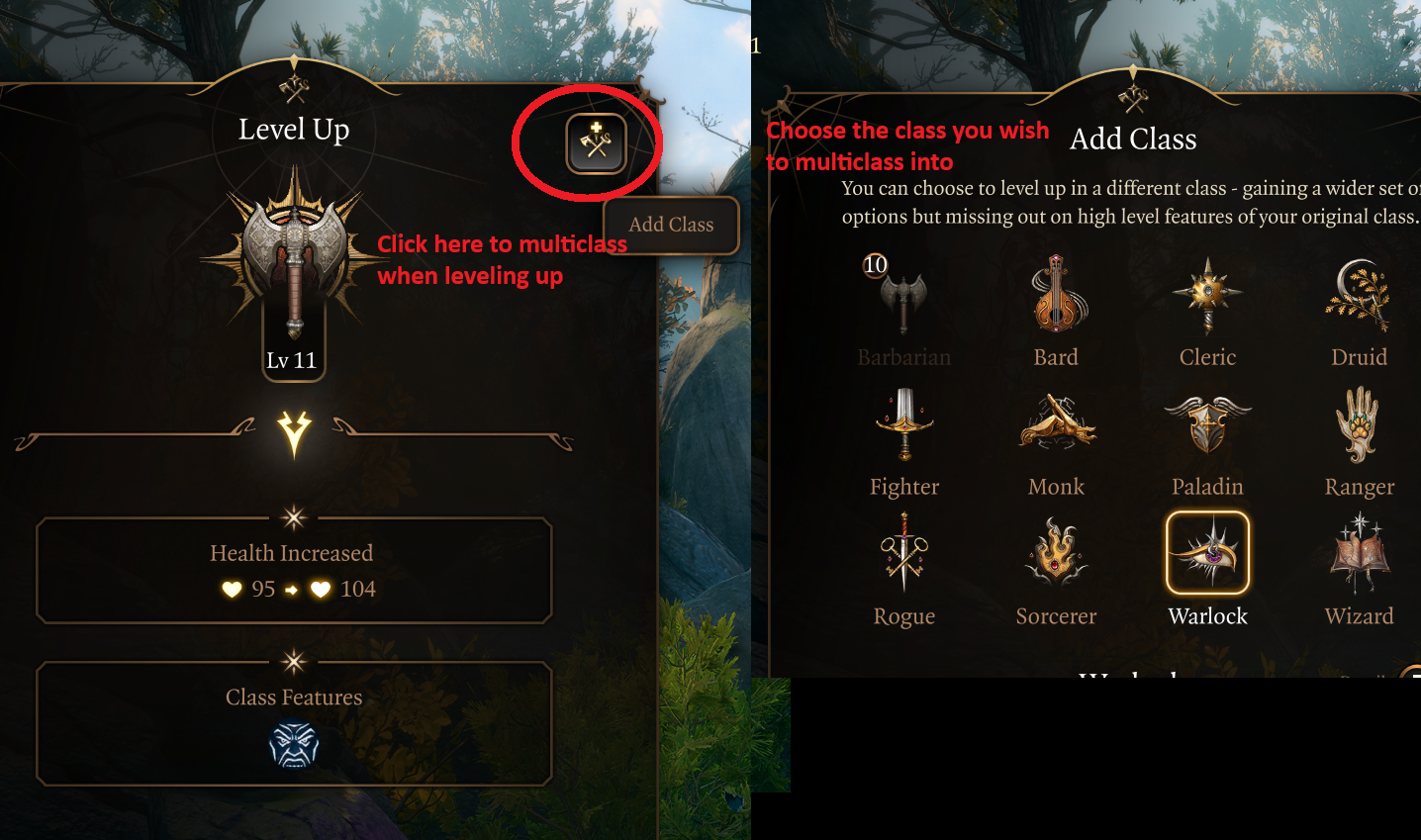
Now you can continue with Druid, and repeat the steps from level 1 to 11, with similar choices. You can multiclass via level up screen:
With this done, you will have the full build setup
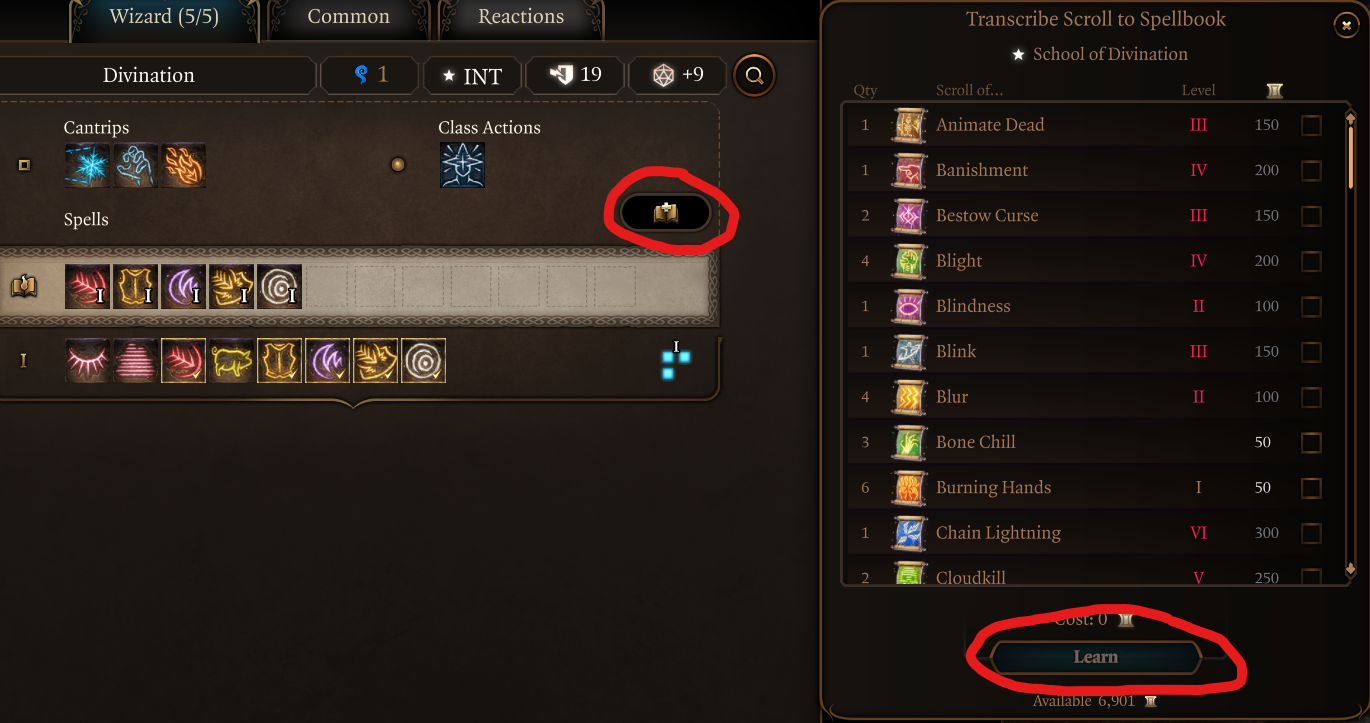
You can only learn spells that you have spellslot access to. So, for example, with a Level 3 wizard, you can scribe up to Level 2 spells. With 3 levels of Wizard + 2 levels of cleric, you can scribe 3rd level spells.
Does this mean the Wizard is the ultimate caster pick? Not really, you can still use a limited amount of spells, and most of them are useful situationally. Moreover, spells learned via Spell Scribing will use Intelligence, and many builds have really low ability scores on this one.
The second stage, after you learn or scribe spells, is that you can then "prepare" them. This means that you can have a limited number of spells active at a time.
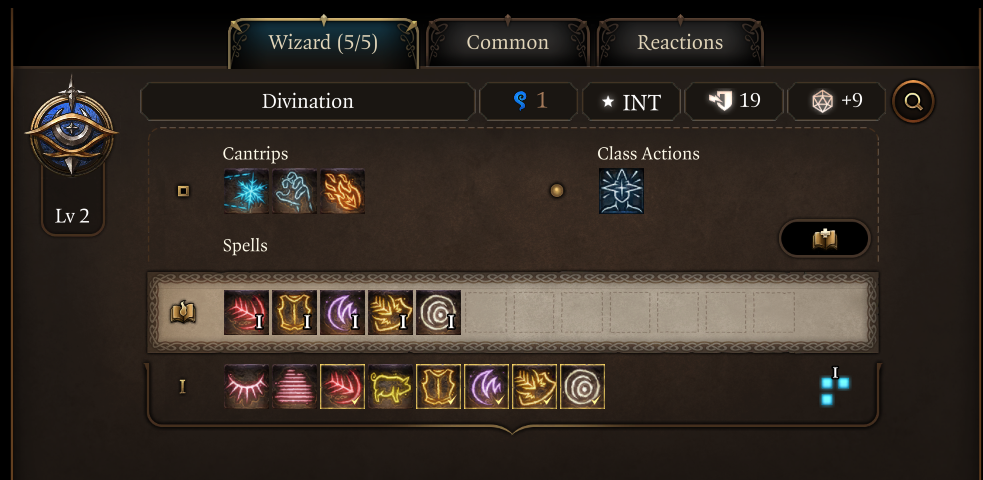
You will have only 1 spell slot available, and this will be taken by a summon - Deva, which you will learn with the  Scroll of Bestial Communion.
Gear Recommendations
Build ID: 58
Mode: Full Equipment
Sets: Act 3
Gameplay and mechanics
In general, Act 3 does not bring much in terms of how the gameplay changes. It's just optimisations to your gear and higher-level spell unlocks
Obtaining Deva
In Act 3 - Lower City, as you go to Sorcerous Sundries, you can access the Sorcerous Vault. There, you will need to find a book - Caution Before the Seelie. Once you read it, you will get the Scroll of Bestial Communion, which the Wizard can scribe.
After scribing and preparing the spell, you can use  Sights of the Seelie: Summon Deva to summon Deva. The cool thing is that after you summon it, you can change the prepared spells, and it will not disappear. There are good alternative spells like
  Globe of Invulnerability.
Constantly Proning targets
Your ghouls shine when enemies are lying on the ground either from Prone or from Sleeping. Act 3 gives access to very powerful boots -  Bonespike Boots. They have
  Brutal Leap action, which at first glance would not seem very special. However, it does use your Spell Save DC. So it means you have a very high chance of inflicting Prone on enemies when you use it.
Moreover, this effect is for 2 turns, so enemies still have to waste their movement speed to stand up.
Unlocking Danse Macabre
As we talked previously, in Act 1, you obtain the book - Necromancy of Thay. Well, in Act 3, you can read a special book found in Sorcerous Sundries called The Tharchiate Codex. Once you read it, you can now further open Necromancy of Thay and read the last page. This will reward the Danse Macabre spell.
Why is the spell special? Well, it isn't, but it's a nice addition for the Necromancer theme:
- The spell is free to cast
- You get 4 summons
- They can deal decent damage, but also act as meat shields
- Sadly, you can't control them, so sometimes they will make suboptimal decisions.
Maximise the amount of the level 6 spell slots.
In the late game, you have multiple sources of level 6 spells from Conjure Elemental to Animate Dead and offensive spells like Sunbeam. Thankfully, you do have various ways to get plenty of level 6 spell slots:
 Arcane Battery from either
  Markoheshkir or
  Staff of Spell Power
 Spellcrux Amulet to restore a level 6 spell slot
 Consume Life Essence from the Staff of Cherished Necromancy for a free level 6 spell
As you see, you have plenty of ways to cast the most powerful spells in the game between each long rest.
The amount of summons
 Crypt Lord Ring - allows the use of
  Create Undead to summon a mummy
- Danse Macabre - 4 ghouls
- Animate Dead with its 3 flying ghouls
- Sights of the Seelie: Summon Deva - Deva
- Conjure Elemental - either Water elemental or Myrmidom
- Conjure Minor Elemental - 2 mephits
- Conjure Woodland Being - Dryad
- Fallen Lover - Wood Woad summoned via Dryad
- Second Marriage - to summon Connor
 Conjure Us - summon the ally from the Nautiloid
- Fungal Infestation - 4x zombies
 Summon Quasit or
  Find Familiar: Scratch for an additional follower.
This can reach a result of 20 summons, which is ridiculous. To be fair, I would mainly concentrate on Animate Dead, Conjure Elemental, Conjure Woodland Being, and Sights of the Seelie: Summon Deva; the others are optional in my opinion.
The recommended combat loop
As I mentioned, the combat loop stays more or less the same from the previous Act 2 (check that out if you missed it).
- Be sure to activate
 Kereska's Favour from Markoheshkir -
  Bolts of Doom or
  Bone-Shaking Thunder. These will give free spells to cast and additional improvements.
 - Use Bonespike Boots every turn, you can use Brutal Leap to force enemies Prone. This is a huge enabler for your ghouls as they get an easy Advantage and can use Devour for a significant damage boost.
- Remember to use Heroes' Feast to buff summons. You can also use Cloudkill to effectively cover a large area in poison without worrying about receiving damage
- Utilise control spells that weaken enemies or enable your summons for higher hit chance and damage - Blindness, Confusion, Hold Person, etc
- You can also get some
 Elixir of Cloud Giant Strength and use these to empower your undead with higher strength values.
 - Phalar Aluve is still the top-tier weapon option, as it can empower undead with Phalar Aluve: Melody
- Overall, the goal is to weaken enemies so that your summons would have an easier way of hitting them.
- Be sure to run Symbiotic Entity and equip
 Armour of the Sporekeeper, this will enable the use of
  Haste Spores, which doubles the number of attacks for your minions.
 - Sunbeam can be an extremely potent spell if enemies are in an aligned place. Similarly, Wall of Fire is a powerful option, which uses a lesser spell slot.
Maximizing - Abilities, Illithid Powers, Consumables
Maximising Ability Scores
Now, as the build progression is covered, there are a few aspects and important decisions you will have to make throughout the game. These will decide your final score for abilities.
Intelligence
- 17 Wisdom - the base for character creation.
- Act 1 - Auntie Ethel's Hair - you will want to get +1 Wisdom if you pick this choice.
- Feat- Ability Improvement - +2 Wisdom.
- Act 3 - Mirror of Loss - pick +2 Wisdom.
These will allow you to reach 22 natural Wisdom, depending on the various choices. This results in a +6 spellcasting modifier and improved Spell Save DC.
Illithid Powers
This special mechanic in Baldur's Gate 3 allows you to consume tadpoles and unlock special Illithid Powers.
At first, you can only use the base powers. As you move to Act 3, you will be able to unlock the outer ring powers, also called Elite.
| Illithid Power | Type | Description |
|---|---|---|
 Favourable Beginnings Favourable Beginnings |
Base | Beneficial power to take as it does not have any costs, and provides only benefits on the first hits with attack rolls. |
 Luck of the Far Realms Luck of the Far Realms |
Base | An easy way to ensure you land critical hits. |
 Cull the Weak Cull the Weak |
Base | Can help to kill an enemy faster if it is left with a few HP. |
 Psionic Backlash Psionic Backlash |
Base | A great way to weaponise your reaction before obtaining  Counterspell. Counterspell. |
 Shield of Thralls Shield of Thralls |
Base | Excellent option for bonus temporary HP. It can also apply  Stunned on foes after it is destroyed. Stunned on foes after it is destroyed. |
 Illithid Expertise Illithid Expertise |
Elite | Can be used to maximise the effectiveness of charisma-based skills, especially relevant to the main character. |
 Black Hole Black Hole |
Elite | Very powerful spell that can be used to pull enemies together. You can then follow up with area-of-effect spells or attacks. In general, it is a very effective action in the hands of any character. |
 Psionic Dominance Psionic Dominance |
Elite | Can be used to save yourself from a deadly spell. This is especially relevant as you will have a  Disadvantage on mental saving throws. Disadvantage on mental saving throws. |
 Freecast Freecast |
Elite | Remove the cost of spell slots or charges. |
 Mind Sanctuary Mind Sanctuary |
Elite | You can now use action and bonus action interchangeably, giving two full spell casts each turn. It's not as important for you, but it will help other casters in the group. |
 Fracture Psyche Fracture Psyche |
Elite | Weakens enemies by reducing their Armour Class. Now it's easier to hit them. |
Potions, Elixirs and other Consumables
Let's take a look at what consumables you can use to further empower the build.
Potions
These are general consumables, and most of them are activated for a few turns. Potions are separate from Elixirs and can be active together.
| Consumable | Description |
|---|---|
| Potion of Speed |
This is a very powerful potion. It gives an additional action point, which can be used to cast a spell or attack. The activation is generally by drinking using a bonus action. However, you can stack together with party members and make one member  Throw it on the ground, giving Hastened to everyone. Throw it on the ground, giving Hastened to everyone. |
 Potion of Invisibility Potion of Invisibility |
It can be used in two ways - the first one is to enter combat with a  Surprised round, causing enemies to skip their turn. Another option is to leave combat if you see that it is not going in your favour. Surprised round, causing enemies to skip their turn. Another option is to leave combat if you see that it is not going in your favour. |
 Potion of Animal Speaking Potion of Animal Speaking |
An easy way to get the  Speak with Animals effect. Speak with Animals effect. |
 Terazul Terazul |
Gives  Hastened and stacks with other sources of it. This is a late-game consumable. Hastened and stacks with other sources of it. This is a late-game consumable. |
Elixirs
Unfortunately, only one Elixir can be active at a time. However, the good thing is that they last until a long rest, making them very useful and economical.
Be sure to activate them before combat, as otherwise, you will need to use Bonus Action.
| Consumable | Description |
|---|---|
| Elixir of Hill Giant Strength |
Sets the strength value to 21 until the Long Rest. This is a perfect option for your summons, as they can drink it when you control them by right-clicking on the elixir. Here is a farming guide for Elixir of Hill Giant Strength. You can then set the strength to 8 and put those points elsewhere. |
| Elixir of Cloud Giant Strength |
Improved version, which will give even more power to your summons. |
 Elixir of Bloodlust Elixir of Bloodlust |
The elixir gives an easy option to get an additional action point - just kill a foe. This can then be used to attack one more time or cast a full spell. |
 Elixir of Battlemage's Power Elixir of Battlemage's Power |
Improves Spell Save DC, making it easier to land spells. |
 Elixir of Peerless Focus Elixir of Peerless Focus |
Makes it easier to maintain spell Concentration |
 Elixir of Vigilance Elixir of Vigilance |
For some encounters, you will want to go first. This elixir will ensure that it overcomes even Surprised mechanics. |
Scrolls
This is one of the most overpowered mechanics in the game. At first, it might seem that you earn those old, boring spells that you can learn yourself. However, as you play more and more, and get higher-level spells, you can see - wait, I can save a spell slot casting this.
Yeah, and this is where their power comes. During the whole playthrough, you will probably collect a lot of these, so I recommend using them whenever you can.
Conclusion
Thank you for reading the Spore Summoner Build for Baldur's Gate 3. This build has been a feast, and I really enjoyed writing it. It offers both a powerful caster and a flavourful setup that you can use both in party play and solo. Glad you read it!
Cheers!
Credits
- Sal - thanks for his ideas and sharing the summon strategy.
Like, Dislike, comment, or share!


Join the Discussion
0 commentsNo comments yet.
Be the first one to leave a comment!